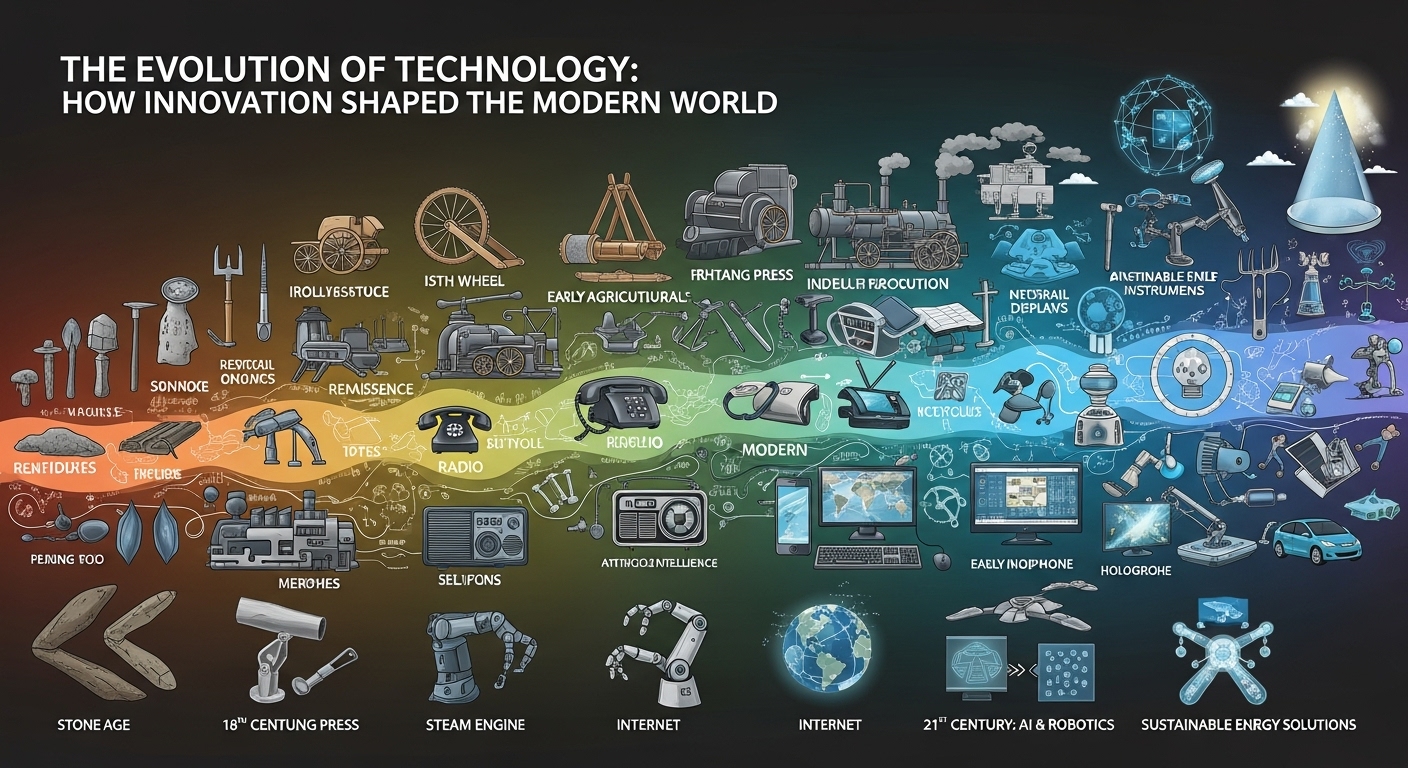
Technology is the invisible hand that has shaped human civilization from the earliest days of discovery to the hyperconnected digital age we live in today. Every invention, from the discovery of fire to the rise of artificial intelligence, reflects humanity’s unending desire to solve problems, expand knowledge, and enhance life. The story of technology is, in truth, the story of humankind itself — a tale of curiosity, creativity, and courage to build the impossible.
The Dawn of Human Ingenuity
Long before silicon chips and satellites, the first humans were already inventors. The creation of simple stone tools marked the dawn of technological progress. Early humans used sharp stones for hunting and cutting, leading to more efficient survival methods. This era laid the foundation for what would become an endless pursuit of innovation. Fire was perhaps the first great leap in technology. It provided warmth, protection, and a new way to cook food, changing human biology and society forever. The control of fire allowed communities to settle, gather, and communicate around flames, forming the first threads of civilization.
As time passed, agriculture emerged as another transformative innovation. The shift from hunting and gathering to farming was not only a technological advancement but also a social revolution. Humans began to manipulate the land, domesticate animals, and produce surplus food, which encouraged settlement and population growth. This agricultural revolution led to the creation of villages, towns, and eventually great civilizations.
The Age of Discovery and Early Engineering
As civilizations expanded, so did the need for better tools, infrastructure, and organization. The ancient Egyptians, Greeks, and Romans became masters of engineering and design. The pyramids, aqueducts, and temples were not merely architectural wonders but testaments to human intellect and technological mastery. Simple machines such as levers, pulleys, and wheels became the basis of complex construction. Mathematics and geometry turned into practical sciences, applied to architecture, navigation, and trade.
The ancient world also witnessed the rise of early mechanical devices. The Antikythera mechanism, discovered off the coast of Greece, is considered one of the earliest known analog computers, capable of tracking celestial movements. Similarly, Chinese inventors contributed to the global spread of technology with innovations such as papermaking, gunpowder, and the magnetic compass — all of which would later change the course of history.
The Printing Press and the Knowledge Revolution
The fifteenth century introduced one of humanity’s most transformative inventions: the printing press. Developed by Johannes Gutenberg, this technology made it possible to reproduce books on a large scale. Before the printing press, knowledge was confined to the elite, written and copied by hand in monasteries or royal courts. Printing democratized information, fueling education, science, and the arts.
The Renaissance that followed was, in many ways, powered by the press. Scientists like Galileo and Copernicus could distribute their findings widely, challenging long-held beliefs and laying the groundwork for the Scientific Revolution. Ideas traveled faster than ever before, igniting an age of questioning, discovery, and creativity.
The Industrial Revolution: From Hand to Machine
The eighteenth and nineteenth centuries marked another monumental shift — the Industrial Revolution. Technology moved from human and animal power to mechanical energy. The steam engine became the heart of this transformation, powering factories, ships, and trains. For the first time, production could be scaled beyond human limitation.
Textile manufacturing, mining, and transportation underwent radical changes. The telegraph introduced the concept of instant communication over long distances, shrinking the world and paving the way for the information age. Urbanization followed industrialization, as people flocked to cities in search of work. However, this progress also brought social challenges such as labor exploitation and environmental degradation. Yet the momentum of innovation could not be stopped.
The Industrial Revolution was not just about machines; it was about the birth of a new mindset — one that saw technology as a driver of progress. Inventors like James Watt, Alexander Graham Bell, and Thomas Edison embodied this spirit, producing innovations that defined modern life: electricity, telecommunication, and mechanized production.
The Rise of Electricity and Communication
The discovery and harnessing of electricity changed the world more profoundly than almost any other advancement. Electricity became the new lifeblood of society, powering homes, industries, and communication systems. The light bulb extended the day beyond sunset, transforming work and leisure alike. Telegraphs evolved into telephones, connecting voices across continents.
By the early twentieth century, the radio allowed information and entertainment to reach millions simultaneously. The airwaves carried voices, news, and music, creating a shared cultural experience. Later, television added images to sound, bringing the world into living rooms and shaping public opinion like never before.
The Digital Revolution Begins
If the industrial age mechanized production, the digital age mechanized information. The invention of the computer in the mid-twentieth century marked the dawn of a new technological era. Early computers like ENIAC and UNIVAC were massive, room-sized machines, but they represented an unprecedented leap in human capability — the ability to process data at speeds far beyond human calculation.
The transistor, invented in 1947, miniaturized technology, making computers smaller, faster, and more efficient. Integrated circuits followed, and soon the personal computer was born. By the 1980s, technology was no longer confined to laboratories or corporations; it entered homes, classrooms, and offices.
The Internet: The Global Brain
The emergence of the internet transformed communication and knowledge once again, just as the printing press had centuries before. What began as a military research project evolved into the backbone of modern civilization. The internet connected computers, then people, and finally, entire economies.
Email replaced letters. Websites replaced libraries. Social networks replaced town squares. The web turned the world into a digital village where ideas, art, and commerce moved at the speed of light. It broke down barriers of geography and class, giving a platform to anyone with a connection and a voice.
Yet the internet was not without its challenges. Issues of privacy, misinformation, and cyber security emerged as new forms of social and ethical dilemmas. Still, its power to connect and empower outweighed its risks, setting the stage for the next great leap — the age of data.
The Smartphone Era: Technology in Your Pocket
The twenty-first century introduced the device that would redefine daily life: the smartphone. Combining the power of a computer, a camera, and a communication tool, the smartphone became an extension of human identity. It placed the internet in every hand, allowing instant access to information, navigation, and entertainment.
Applications turned phones into multifunctional devices — tools for work, creativity, and social connection. The digital economy flourished as mobile technology reshaped industries from transportation to healthcare. The rise of mobile apps, digital payments, and social media changed how people shop, learn, and interact.
Smartphones also accelerated globalization. A person in a remote village could now communicate with someone across the planet instantly. Technology had finally achieved what ancient traders and explorers dreamed of — a completely interconnected world.
Artificial Intelligence and Automation
Today, the frontier of technology is defined by artificial intelligence. AI has evolved from simple algorithms into sophisticated systems capable of learning, reasoning, and adapting. Machines can now recognize faces, translate languages, and even create art. Automation has extended into industries like manufacturing, logistics, and finance, optimizing efficiency and reducing human error.
The promise of AI lies in its potential to augment human ability. In medicine, AI assists in diagnosing diseases earlier and more accurately. In education, intelligent tutoring systems personalize learning experiences. In business, algorithms analyze massive datasets to predict trends and guide decision-making.
However, the rise of AI also raises questions about employment, ethics, and control. As machines take over repetitive and analytical tasks, humans must redefine their roles in a world driven by intelligence both natural and artificial.
The Internet of Things and the Smart World
Another major leap in recent years has been the emergence of the Internet of Things (IoT). Everyday objects are now embedded with sensors and connected to the internet, creating networks that communicate and respond in real time. Smart homes adjust lighting and temperature automatically, wearable devices track health metrics, and autonomous vehicles navigate traffic with precision.
This interconnected ecosystem of devices has created what many call the “smart world.” Cities are becoming more efficient through data-driven management of traffic, waste, and energy. Agriculture uses IoT for precision farming, reducing resource use while increasing productivity. The blending of physical and digital worlds has become seamless, enhancing convenience and sustainability.
Cloud Computing and the Age of Data
The digital transformation of the twenty-first century depends heavily on data. Every interaction, transaction, and communication generates information. Cloud computing emerged as the infrastructure to store, process, and manage this vast ocean of data.
Instead of relying on local servers, businesses and individuals now use remote networks to access computing power and storage. This has enabled startups and global corporations alike to scale rapidly and innovate without massive upfront investments. Streaming services, social media, and online collaboration tools all rely on cloud architecture.
The cloud has also empowered artificial intelligence, as vast datasets stored in these networks feed algorithms and enhance machine learning. Data has become the new oil — a resource driving innovation, competition, and progress.
Biotechnology and the Future of Life
Technology is no longer confined to machines and codes; it now touches the fabric of life itself. Advances in biotechnology have opened the door to genetic editing, personalized medicine, and synthetic biology. Scientists can now modify genes to prevent diseases, grow organs in laboratories, and design new materials inspired by nature.
During global health crises, technology has played a critical role in vaccine development, data tracking, and telemedicine. The integration of biology and technology hints at a future where human longevity, health, and capability could be redefined. Yet it also forces society to confront ethical questions about the limits of intervention and the definition of humanity.
The Role of Technology in Society
Technology has always been a double-edged sword. It empowers and disrupts, creates and destroys. Every new wave of innovation brings opportunities and challenges. Social media, for example, has revolutionized communication but also amplified misinformation and mental health concerns. Automation increases efficiency but can displace jobs.
The responsibility, therefore, lies in how technology is used. Ethical frameworks, education, and global cooperation are essential to ensure that innovation serves humanity rather than undermines it. Technology should not merely make life faster or easier; it should make it more meaningful, equitable, and sustainable.
Sustainability and Green Technology
In recent years, the growing awareness of climate change has driven a new wave of innovation focused on sustainability. Green technology aims to reduce carbon emissions, conserve resources, and protect ecosystems. Renewable energy sources such as solar, wind, and hydro power are becoming mainstream. Electric vehicles are replacing fossil-fueled transportation, and smart grids are optimizing energy consumption.
Technology also plays a vital role in monitoring the environment. Satellites and sensors provide real-time data on deforestation, pollution, and weather patterns. Artificial intelligence helps predict natural disasters, while biotechnology explores eco-friendly materials and carbon capture solutions.
The intersection of technology and sustainability represents one of humanity’s most important missions — using innovation not only to advance civilization but also to preserve the planet that sustains it.
The Human Element in the Age of Machines
As technology grows ever more intelligent, it is easy to fear the loss of the human touch. Yet, paradoxically, technology also enhances human creativity and empathy. Digital art, virtual reality, and online collaboration allow people to connect across cultures and express themselves in new ways.
The next frontier may not be about building smarter machines but about fostering smarter humanity. Education, emotional intelligence, and digital ethics will be the guiding principles of the future. The challenge is not to compete with machines but to coexist with them — to use them as extensions of our imagination and compassion.
The Future of Technology: A Glimpse Ahead
Looking ahead, the pace of technological change shows no sign of slowing. Quantum computing promises to revolutionize computation by processing information at unimaginable speeds. Space technology is advancing rapidly, with private companies pushing the boundaries of exploration. Augmented and virtual reality are redefining how we experience the world, blending the digital and physical in unprecedented ways.
Meanwhile, breakthroughs in neuroscience hint at the possibility of direct brain-computer interfaces, merging thought and technology. These developments raise profound philosophical questions about consciousness, identity, and free will. The line between human and machine continues to blur, suggesting a future both awe-inspiring and uncertain.
Conclusion: The Endless Journey of Innovation
From the first spark of fire to the rise of artificial intelligence, the journey of technology is a testament to humanity’s boundless curiosity and determination. Every generation inherits tools from the past and reshapes them for the future. Innovation is not merely about machines; it is about imagination — the uniquely human capacity to dream of what does not yet exist.
As we stand at the threshold of a new technological epoch, one truth remains constant: technology is only as good as the values that guide it. The challenge for the modern world is not to slow progress but to direct it wisely — toward equity, sustainability, and the flourishing of life in all its forms.
The evolution of technology will never truly end, because the human spirit of discovery will never rest. The same fire that once burned in ancient caves now burns in circuits and algorithms — a flame of curiosity lighting the path toward tomorrow.